Social emotional learning resources for classrooms that children remember
The Little Pebble Books combines gentle stories, ready-to-use curriculum, printable tools, and emotional regulation supports to help children feel safe, connected, and ready to learn.
Choose the path that fits your work
Whether you support children in a classroom, counseling space, or at home, these tools were designed to meet you in the real moments that matter most.
For Teachers
Story-based SEL tools for morning meeting, calm corners, read-alouds, transitions, and everyday classroom support.
For Therapists, Counselors, and Social Workers
Gentle, child-friendly books and emotional support tools that help children name feelings, build safety, and begin hard conversations.
For Homeschool Families
Meaningful stories and simple emotional tools you can use at home to help children feel safe, understood, and connected.
Get your free classroom starter pack
Pebble Breathing card • Young Toby Meet & Greet page • Sample morning meeting guide • I Am Brave coloring page
You will also receive occasional updates about new resources, books, and program news. Unsubscribe anytime.
Gentle tools for the children you care for every day
Story-based social-emotional learning resources created to help teachers support big feelings, build connection, and bring calm, belonging, and emotional language into everyday classroom moments.
You Matter. You Make a Difference.
You already know which children in your classroom are carrying something heavy.
You can see it in the way they hold themselves. In the moments that fall apart without warning. In the child who cannot find the words for what is happening inside them — and so it comes out sideways.
You did not become a teacher or a counselor to manage behavior. You became one because you believed every child deserved someone who saw them.
The Little Pebble Books was built for exactly that belief. And for you.
Built from the Inside Out

Most SEL resources are created by researchers and clinicians writing about experiences they have studied. This one is different.
Trauma-informed is not a label we added. It is where this program was born. Every tool, every story, and every resource was created by someone who knows what it feels like to be the child in the room whose feelings are too big for their body — a trauma survivor, foster mother, and adoptive parent who has sat with children in their hardest moments and built what was missing.
Most SEL curricula are written in research settings and tested in controlled environments. This one was written at 2am beside a child who could not regulate — and refined every time something actually worked. The Little Pebble Books curriculum grew directly from the books, from the children, and from the teachers who kept asking for more. It is not a program layered onto a classroom. It is a natural extension of stories children already love — tools that feel like the next page of the book rather than a separate lesson.
Built by a mother who searched everywhere for what her children needed, could not find it, and built it herself. Because when a child is dysregulated, they do not need a framework. They need someone who understands.
That is not a credential you can earn in a classroom. It is one you earn in a life.
Two versions of one beloved character

The Story Toby
Story Toby walks on four legs through the world of The Pebble. He is Penelope’s quiet, patient companion — always present, never intrusive, watching over the story the way a trusted friend watches over a child. He is the face of the brand, the logo, the one who appears on every book cover.
“Story Toby watches over the books.”

Young Toby
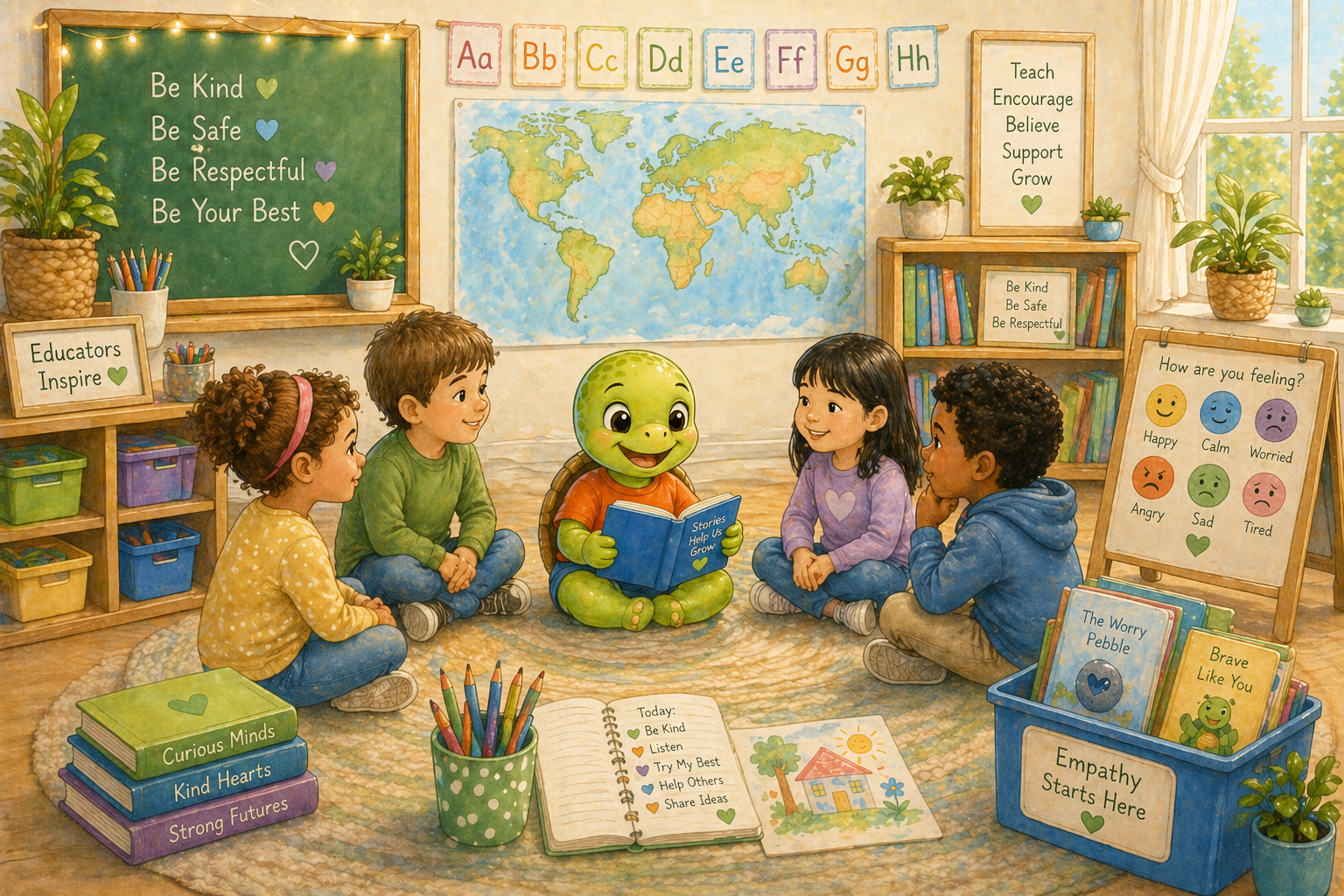
Young Toby stands upright, wears a red shirt and jeans, waves hello, and makes eye contact. He is expressive, warm, and child-level in every way. He is the same turtle — just younger and more relatable, designed to sit in the classroom circle with your students.
“I’m a little turtle, and I’m still learning — just like you.”
“Young Toby lives in the classroom with the children.”
Why two Tobys matter for your classroom
When a child meets Storybook Toby in the story and then sees Young Toby in their classroom resources, something gentle happens.
The connection is immediate.
The character they fell in love with in the book is now in their calm-down corner. In their breathing card. In their morning meeting.
The story and the classroom begin to feel like one continuous world.
CASEL-Aligned Social-Emotional Learning
The Little Pebble Books supports all five CASEL core competencies. Every story, tool, and curriculum resource is designed to fit naturally into the emotional learning goals schools are already working toward.
This makes the program easy to document, easy to explain to administrators, and easy to integrate into the SEL goals your school already has in place.
Designed for educators who are already carrying a lot
These books and printable supports are designed to make social-emotional learning feel more natural, more gentle, and easier to use in everyday moments. Whether you are helping a child name a feeling, settle their body, feel included, or find their voice, these tools are here to support the work you are already doing.
The Books
Each book targets a specific SEL theme and can be used as a standalone read or as part of a series. Tap any book to purchase on Amazon.


Why teachers use these books
To help children talk about feelings in ways that feel safe and simple
To support regulation, belonging, confidence, and emotional literacy
To create gentle entry points for classroom conversations that matter
To pair meaningful story experiences with practical follow-up tools
More than a book series.
A complete SEL ecosystem for children ages 3–8, PreK through Grade 5.
The Little Pebble Books is a complete, CASEL-aligned social-emotional learning program for children ages 3–8, spanning PreK through Grade 5. It is not simply a book series. It is a comprehensive ecosystem of stories, regulation tools, educator resources, and family supports — all built around a single guiding belief:
“Children do well when they feel safe, supported, and understood.”
This program includes:
This program was not born in a research study or a classroom. It was born in a life. It was built from real lived experience, for the children who need it most and the educators who love them.
Every book in the series was written for a real child — a child the author has loved, held, and walked alongside through trauma, fear, and healing.
Because the children who need these books the most deserve stories that were written with them — not just for them.
Tools for the Difficult Moments at Home
When a child is dysregulated, they do not need a framework. They need something simple, steady, and safe to return to.
Because sometimes the body needs to move before the mind can settle.

Every tool was built for a real moment — the morning when feelings are too big, the transition that falls apart, the child who cannot find the words.
Start Here
When your child is overwhelmed, their brain is in survival mode. You cannot reason with survival mode.
But you can give the body something steady to hold onto — something that gently brings them back before the next moment, the next task, the next transition in your day.
You do not need to fix everything. You just need a place to begin.
🪨 Pebble Breathing
Start small. Have your child hold a small smooth stone — or simply cup their hands as if they are. Breathe in slowly. Breathe out slowly. Feel the weight. Feel the steadiness.
Let the body settle first. The mind — and the learning — will follow.
🐢 Turtle Shell Calm-Down
When feelings feel too big, we go small. Pull in tight like a turtle in its shell. Take a slow breath in. Hold. Then gently release. This works at the table, in their room, or anywhere they need it.
Your child is learning something important here — how to return to themselves.
🐦 Fly Like a Birdie
Some feelings do not want to sit still. Stretch your arms like wings. Breathe in as they rise. Breathe out as they fall. Use this between subjects, after something hard, or before a difficult moment.
They do not need to be calm to begin. They just need to begin.
🌊 Ocean Breathing
For the moments that need slowing. Breathe in as the wave comes in. Breathe out as it goes. Slow. Steady. Rhythmic. You can do this right alongside them.
No two waves are the same. Just keep breathing.
You do not have to do this perfectly. You just have to show up.
Small moments like these — again and again — are how children learn they are safe enough to learn.
Trauma-Informed by Design
These books were not written from a textbook. They were written from lived experience — by a foster and adoptive mother who knows what children in hard places carry, and what they need to feel safe enough to learn.
Everything Your Classroom Needs — From Day One

What this looks like in your classroom
The Little Pebble Books does not require a new curriculum period or a new lesson plan structure. It fits inside what you already do — and makes it work better.


Ten to fifteen minutes a day.
That is the whole program. The rest happens naturally — because the stories do the work.
What the data says about SEL programs like this one
Full research summary available — covering SEL outcomes, trauma-informed approaches, and why emotional safety is a prerequisite for academic learning.
And while the heart of this work is what children feel — the research quietly supports it too.
The strongest impact is consistently in one area: children feeling safe, seen, and like they belong.
Ready to see the full picture?
See the ResearchThis program was built from lived experience.
This curriculum grew because of my children. When my adopted boys came home from the system, they brought with them everything they had survived — trauma, big feelings that had no words, and pain that did not always have a safe place to go.
And they were not alone. Over the years, many children came through our home through foster care — each one carrying their own history, their own weight, and their own particular way of bracing for the next hard thing.
I watched them struggle in classrooms with teachers who genuinely wanted to help. Teachers who could see that something deeper was happening, but did not always have the tools to meet those children where they were.
So I went looking. I attended conferences. Took every class I could find. Read everything I could get my hands on. And I kept coming back to the same problem — nothing was quite the right fit.
So I stopped looking for what already existed and started building what was needed. Not because I had all the answers, but because I had lived the questions long enough — and loved enough children carrying them — to know what the answers needed to feel like.
Then teachers started asking. What is that breathing practice? Do you have something I could use with the whole class? Could you write that down?
That is how the curriculum grew. One tool at a time. One child at a time. One teacher who was trying so hard and just needed something to help.
This is that something.
Who built this
Trish Iiams is a mother first — long before fostering, and still today — as well as a trauma survivor, foster mother, adoptive mother, grandmother, and homeschool parent. She is also the author of The Little Pebble Books — a series built not from research alone, but from a life spent loving children through their hardest moments.
She has watched children struggle in classrooms with teachers who genuinely wanted to help — who could see exactly what was happening — but did not always have the tools to meet them where they were. She has been the person at the table searching for something that would truly work — and not finding it.
So she built it herself. Not because she had all the answers, but because she had lived the questions long enough — and loved enough children carrying them — to understand what the answers needed to feel like.
And then the teachers started asking. That is how the curriculum grew — one tool at a time, one child at a time, one educator who was trying so hard and just needed something to help.
“Because even the smallest heart can make a difference.”
What Educators Are Saying
Real words from the classrooms where these books are already making a difference.
Four ways to bring this into your classroom, school, or district
Whether you are a classroom teacher starting with one book, a counselor building a calm corner, or a district leader exploring a wider rollout — here is exactly how to begin.
Start with one book
The Pebble is where the program begins — it introduces the characters, launches Pebble Breathing, and builds classroom community from day one.
Get The Pebble on AmazonDownload free classroom resources
Free tools ready to use tomorrow — Pebble Breathing card, Young Toby Meet & Greet, sample morning meeting guide, and an I Am Brave coloring page. No email required.
Download Free ResourcesAccess the full curriculum
Teachers, counselors, and school teams receive access to the complete curriculum — all 8 books with lesson plans, CASEL alignment documentation, Young Toby SEL resources, calm corner materials, bilingual family letters, and a school-wide digital license.
Ask About Curriculum AccessBring Trish to your school or district
Author visits, read-alouds, educator workshops, and district keynotes — every engagement includes a book for every participant. School visits start at $12 per student. Workshops from $800.
Ask About a Visit or WorkshopWhat curriculum access includes for educators
The full curriculum gives you everything you need from day one — not just the free starter tools, but the complete classroom library built to work in real everyday moments.
⭐ Pilot Program — Now Open
Select schools receive the complete program at no cost in exchange for honest teacher feedback.
Apply“The children in your classroom need someone who understands what they carry.”
Contact The Little Pebble BooksCreated with children, classrooms, and tender moments in mind
The Little Pebble Books were created to offer children gentle language, emotional safety, and meaningful connection. These resources are especially helpful in classrooms where children may be navigating change, loss, uncertainty, big feelings, identity, belonging, or simply the everyday need to feel seen.
Simple, honest pricing for educators
Everything is designed to be accessible for individual teachers, school counselors, and administrators working with any budget.
One Book
Place a single Little Pebble Book in your classroom library or calm corner.
Printable Resources
Breathing cards, emotion charts, calm corner tools, and discussion prompts available free.
Classroom or School Sets
Full classroom sets, school-wide packages, and author visits — contact us to build the right fit.
Sponsored Books
High-need classrooms may qualify for sponsored books through the Care Program. Contact us to ask.